español




Quick Answer
Can sintered stone be used for outdoor kitchen countertops? Yes, if the slab is made for exterior use. Sunlight won't discolor it the way it can ordinary quartz, and the slab surface generally needs no sealing.
But surviving the weather doesn't make a countertop good to work on. On an open patio, a dark polished top can glare and get too hot to touch. So for an outdoor kitchen range, we'd start with one lighter, smooth, low-sheen finish, and add a second only when it earns its place.
Contents
Sintered stone's fired mineral construction avoids the resin-related UV discoloration associated with ordinary engineered quartz. Outdoor-suitable slabs bring marble looks, concrete effects and other decorative designs into exposed kitchens.
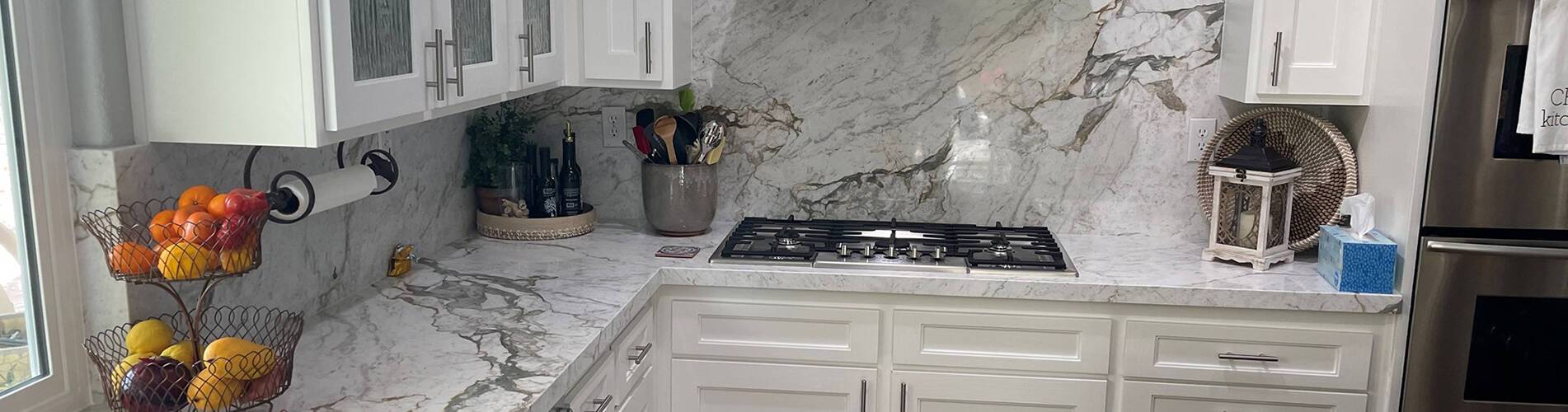
A light marble look can connect an indoor kitchen with a patio kitchen. A concrete effect can complement metal cabinets without using a poured concrete countertop. Marble and concrete looks give cabinet brands and project buyers more freedom to develop a particular appearance.
Marble-look and concrete-look describe the design rather than its outdoor performance. The starting range should be outdoor-suitable; color and finish come next.
Heat resistance is a clear advantage beside outdoor cooking equipment. A hot pan, however, creates a different demand from a barbecue that transfers heat continuously into surrounding surfaces.
The countertop opening needs to work with the grill and the cabinet beneath it. Ventilation space, appliance support and room for heated components to expand belong in the layout before cutting begins. Direct flame contact and excessive radiant heat should be avoided.
For repeat cabinet modules, an agreed grill opening gives subsequent countertop orders a consistent starting point. A different grill model may need a different opening, even when the cabinet looks unchanged.
Low water absorption suits rain-exposed countertops and wet preparation areas. Joints and sink connections need proper sealing to limit water entry. The supporting assembly should also allow water to drain away rather than collect beneath the countertop.
Freezing winters add another requirement: the selected slab needs freeze–thaw resistance. Low water absorption alone does not establish frost performance.
We can discuss suitable slab options around the installation location, direct sun exposure and winter conditions. Those conditions are a clearer starting point than pattern or color alone.
A countertop can withstand outdoor exposure yet still reflect harsh sunlight, feel hot to touch or need frequent wiping. Color, sheen and texture affect these experiences in different ways.
One finish across the island is usually the simplest solution when it meets the main working requirements. A second finish should bring a clear functional or visual benefit.
A smooth, low-sheen surface may work for the preparation counter, serving area and island sides alike. More expressive texture can add interest to a decorative face without appearing on every surface.
| Position | Recommended starting point | Main benefit |
|---|---|---|
| Sun-exposed preparation counter | Lighter color, smooth surface and low sheen | Balances glare, surface heat and routine wiping |
| Covered cooking or serving area | Smooth working surface, with more freedom in color and sheen | Reduced direct exposure allows a broader visual choice |
| Island face or decorative side panel | More expressive texture where it adds to the design | Keeps pronounced texture away from the main preparation surface |
A unified finish simplifies sampling, stocking and repeat-order specifications. Mixed finishes are worthwhile when they improve the result, rather than simply adding another option.
Polished surfaces can create strong reflections in direct sun. Dark colors generally absorb more solar energy than lighter ones.
A charcoal countertop may suit a cabinet collection visually yet become uncomfortable to touch during prolonged sunshine. A low-sheen finish reduces reflection, but it does not keep the surface cool.
For an exposed preparation counter, a smooth, low-gloss surface offers a useful balance between visual comfort and easy wiping. Deep texture is not necessary to reduce glare.
Strong reflections that interfere with food preparation are a poor fit for a working surface. Slightly more visible fingerprints or drying marks are a smaller tradeoff, especially when they wipe away readily. Dark, low-sheen surfaces deserve particular attention because fingerprints and drying marks can be conspicuous.
Grease, sauces and food residue need prompt removal. Routine care generally involves a suitable mild cleaner and rinsing away the remaining cleaner and dirt.
Stain resistance does not mean the surface always looks clean after one wipe. An oily film or dried mark can remain without causing permanent discoloration.
Some low-sheen finishes show everyday marks more readily, while pronounced texture can take more attention to wipe thoroughly. For a frequently used grill-side counter, cleaning convenience matters as much as the appearance of a showroom sample.
Prolonged sunlight can affect the resin binder and pigments in ordinary engineered quartz, changing its appearance. A patio roof does not automatically make an indoor product suitable for exterior use.
Dedicated outdoor quartz collections are a separate option. For projects seeking a manufactured decorative surface outdoors, sintered stone is a strong alternative to ordinary indoor quartz.
Granite is a reliable outdoor countertop material. The choice between granite and sintered stone is about appearance, maintenance and the completed design as well as weather resistance.
| Consideration | Sintered stone | Granite |
|---|---|---|
| Outdoor performance | Resistance to sunlight, heat and moisture in outdoor-suitable products | An established natural-stone choice for exterior use |
| Appearance | Marble looks, concrete effects and other manufactured designs | Natural crystals, movement and slab-to-slab variation |
| Maintenance | The slab surface generally needs no periodic sealing | Sealing needs vary; some stones require periodic treatment |
We recommend sintered stone when the design calls for a marble look, concrete effect or another manufactured pattern with less sealing maintenance. Granite remains a strong choice when natural mineral character is central to the project.
For either material, the actual color and finish determine much of the experience in direct sun. A dark surface can become hot, and a polished face can reflect strongly.
Outdoor-rated porcelain slabs are used for working countertops as well as cladding. Porcelain, sintered stone and ultra-compact surfaces have overlapping applications and sometimes overlapping market terminology. These names alone do not establish a quality ranking.
For standard cabinet runs with continuous, stable support, 12 mm is a practical starting thickness. It keeps weight lower and provides a slim edge.
20 mm suits designs that call for a thicker exposed slab edge. Its additional weight needs to be included in the cabinet and handling plan.
| Thickness | Approximate slab weight | Starting application |
|---|---|---|
| 12 mm | 30 kg/m² | Supported cabinet runs with a slim edge |
| 20 mm | 50 kg/m² | Designs requiring a thicker exposed slab edge |
For 3 m² of countertop, these estimates give approximately 90 kg at 12 mm and 150 kg at 20 mm, a difference of about 60 kg before added components. Actual weights depend on the slab.
A fabricated built-up edge can create a deeper appearance without using equally thick material across the whole countertop. The tradeoff is additional joining and finishing work.
Long overhangs, large spans and closely spaced openings need a suitable support layout. Moving to 20 mm alone does not resolve those requirements. Greater thickness also does not improve UV resistance or make a slab better suited to rain.
Our slab size and thickness guide covers the wider format range.
A marble pattern on the slab face may not continue through its thickness. An exposed edge can look different from the top.
Full-body or through-body color options are worth considering when continuity between the face and edge is important. A consistent body color does not necessarily mean that the marble veining runs through the slab.
A cut-edge sample shows this difference more clearly than a face sample alone. It helps establish whether a simple exposed edge or a fabricated edge will give the intended result.
Edges and corners can chip under impact. Openings, narrow sections and exposed ends need particular care during fabrication, transport and fitting.
Sintered stone prices vary widely across product grades and production processes. Countertop fabrication adds another layer of cost.
A straight preparation counter involves less work than an island with a grill opening, sink, mitered edges and matching side panels. Vein placement and joint layout can also change how much slab material is needed.
The useful comparison is the cost of the same completed design. An attractive slab price may be only a small part of the decision when the countertop includes extensive edge work, openings and matching panels.
| Supply format | Best fit | Main tradeoff |
|---|---|---|
| Full slabs | Projects with changing dimensions or local site measurement | More flexibility, with cutting and slab handling carried out locally |
| Cut-to-size components | Fixed layouts and repeated cabinet modules | Less processing after delivery, with greater protection needed around pre-cut openings and narrow sections |
Who cuts the grill and sink openings should be agreed before production. Factory-cut openings require settled dimensions. Where final measurements will be taken on site, full slabs leave the openings and final shapes to the destination fabricator.
Pre-cut openings leave narrower sections that need protection during packing, transport and fitting. Full slabs also need professional handling.
We supply full slabs and drawing-based components. Cut-to-size pieces can be labeled and packed by kitchen, room or project unit, helping the receiving team identify them without sorting a mixed shipment.
Samples can show the proposed combination before production. Where the worktop and island face use different finishes, they should be viewed together. An exposed-edge design also benefits from a cut sample.
Sintered stone has very low water absorption, and the slab surface generally needs no periodic sealing for stain protection. Joints around sinks and between countertop pieces still need suitable sealing.
Yes. UV resistance and heat resistance do not keep a surface cool. Dark colors generally absorb more solar heat; lighter colors and shade can improve comfort.
Product grades and production processes create a wide price range. Fabrication and installation add to the completed cost. Our sintered stone price guide explains the main price differences.
Sintered stone offers decorative choice, outdoor durability and reduced sealing maintenance. Its main compromises are edge vulnerability and the care needed to fabricate and handle finished pieces.
Excellent Stone supplies sintered stone slabs and drawing-based countertop components. The installation conditions, cabinet layout and location of final cutting provide the basis for discussing material options and a quotation.
Send us your cabinet drawings or a rough layout through the inquiry form or by email, and we'll talk through the slab, the finish and where the cutting should happen. We can send samples of the surfaces and exposed edges too.
Categorías
Nuevo blog
Etiquetas
 ROOM 205,NO.45, MIDDLE HAIJING ROAD,XIAMEN,AREA OF PILOT FREE TRADE ZONE(FUJIAN)OF CHINA
Para Consultas sobre nuestros productos o su lista de precios, por favor, déjanos a nosotros y estaremos en contacto dentro de las 24 horas.



© Derechos de autor: 2026 XIAMEN EXCELLENT STONE CO.,LTD. Reservados todos los derechos.

Red IPv6 admitida