español




Respuesta rápida
El mármol y el granito se deterioran de forma diferente durante el transporte, por lo que el embalaje también debe ser diferente. La mayoría de las instrucciones de embalaje para exportación en este sector están redactadas para la "piedra natural" como una sola categoría, y ahí es donde comienzan muchos de los daños.
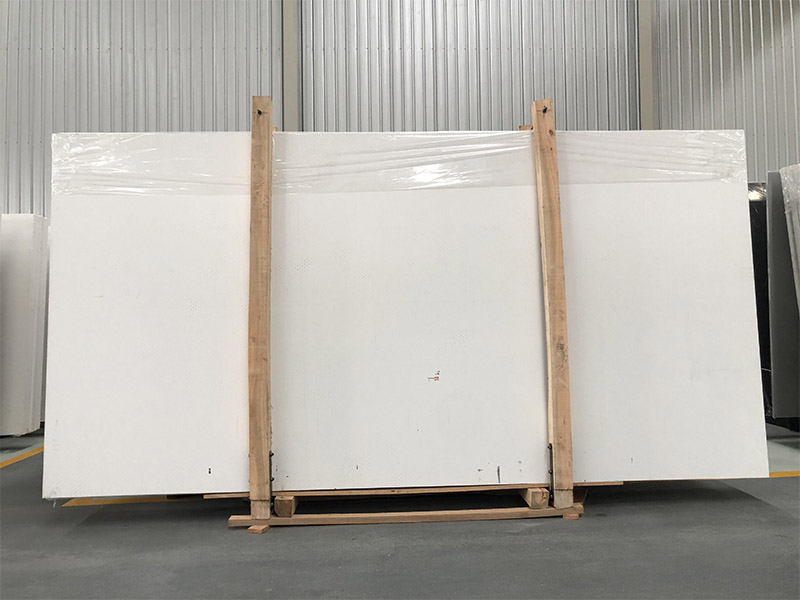
El mármol es una roca carbonatada, más blanda que el granito y más débil en los bordes. El daño que vemos en el mármol casi nunca consiste en una losa partida por la mitad. Se trata de astilladuras en los cantos y esquinas rotas, y se produce cuando la losa se mueve dentro de su propio embalaje. Un paquete con 10 mm de holgura puede astillar el mármol en una ruta que deja el granito intacto.
El mármol pulido también se mancha con mayor facilidad. Si dos superficies pulidas se frotan entre sí durante cuatro semanas, perderán su brillo. Una superficie pulida que se deja en contacto con metal desnudo o con humedad atrapada puede mancharse de forma irreversible, incluso después de volver a pulirla. En el caso de un material blanco o gris claro, el problema es irreversible.
Tres principios rigen el embalaje del mármol. El paquete debe estar bien compactado, sin movimientos internos. Cada cara pulida debe estar separada de la siguiente. Y ninguna superficie pulida debe tocar madera, metal o suelo sin tratar. Todo lo demás se deriva de estos tres principios.
Tres sistemas cubren casi todo lo que enviamos en mármol. El que reciba dependerá de la forma del producto, no del tamaño del pedido. Estas son las configuraciones que utilizamos paraSuministramos losas de mármol y piezas cortadas a medida..
| Tipo de embalaje | Utilizado para | Estructura | Límite de carga |
|---|---|---|---|
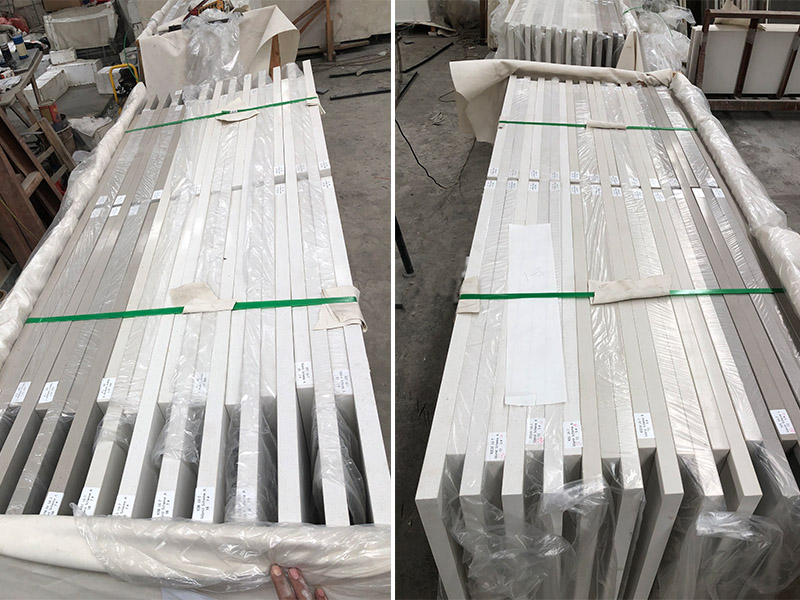
| Paquete de estructura doble de madera en forma de A | Sierra de hilo para cortar grandes losas de 2 cm y 3 cm. | Madera de 50×50–70×70 mm, base de 80×80 mm, espacio libre para montacargas de ≥100 mm | ≤ 2,5 t por paquete |
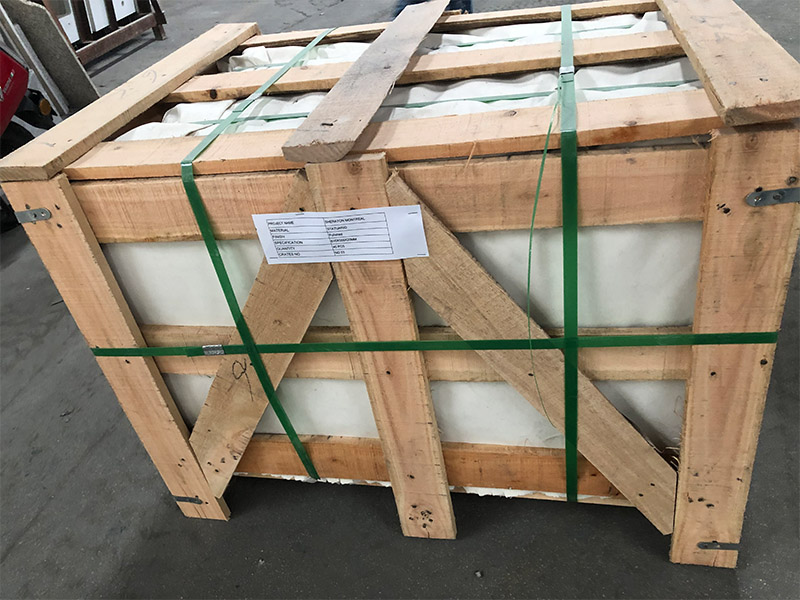
| Caja de madera | Piezas cortadas a medida, azulejos, piezas para proyectos | Base de 18–25 mm, paredes de 12–18 mm, revestimiento de EPE de 10–20 mm. | ≤ 1,5 t por caja |
| Caja de espuma dentro de una caja de madera | Azulejos delgados | Primero se empaqueta en espuma y luego se embala en una caja como se indica arriba. | ≤ 1,5 t por caja |
Esas son las configuraciones estándar. Existen versiones reforzadas para materiales de alto valor o de gran tamaño; consultelo que puede especificar en su orden de compraabajo.
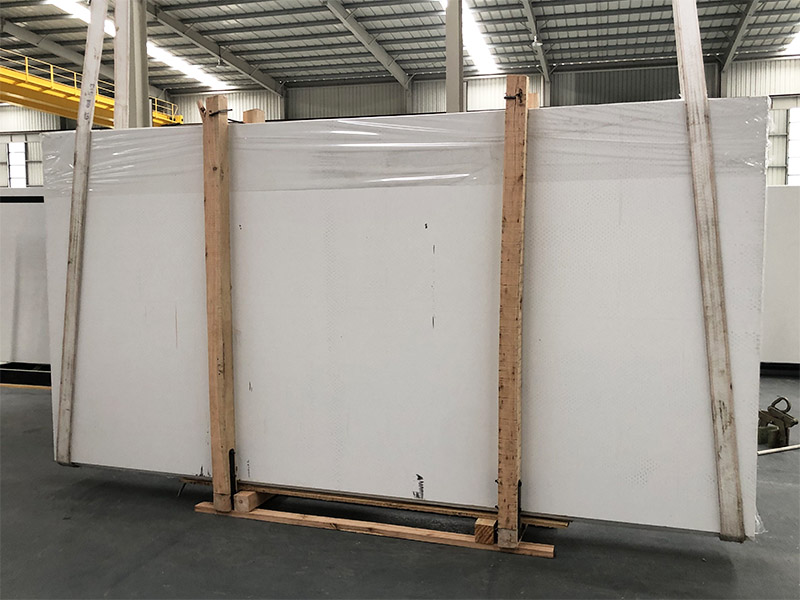
Cada paquete de grandes tablones se coloca en dos marcos de madera, uno con acceso desde cada extremo. Cortamos los marcos a medida para cada paquete, no a partir de un stock de tamaños estándar, porque el ancho interior debe coincidir con el material que se va a introducir.
La madera del marco es de 50×50 mm o 60×60 mm, de pino o madera dura. Para trabajos pesados (material de 3 cm, formatos mayores), llega hasta 70×70 mm. La base se ensancha a 80×80 mm para que el peso se distribuya uniformemente en lugar de concentrarse en dos líneas de contacto, y las uniones entre postes y vigas llevan refuerzos triangulares. Esta es la unión que suele fallar primero. Debajo, dejamos al menos 100 mm de espacio libre para que las horquillas de la carretilla elevadora entren sin problemas y nunca alcancen la piedra.
El ancho interior del marco se establece a partir del espesor total real de las losas que van en ese paquete,más 5–10 mm.
Esa holgura funciona en ambos sentidos. Si se construye el marco demasiado ajustado, presionará la piedra en cuanto la madera se hinche o el contenedor se caliente. Si se construye flojo, todo el conjunto se moverá de un lado a otro durante un mes en el mar. El margen es de cinco a diez milímetros.
Las losas se colocan verticalmente, cara pulida contra cara pulida, con espuma entre las caras y alrededor de los bordes. Levantamos el paquete, introducimos ambos marcos por los extremos y comprobamos el espacio a cada lado antes de fijar nada. Si los marcos y las losas no encajan bien, el paquete se desmonta y se vuelve a armar. Apretarlo más no soluciona un mal ajuste. Luego, los marcos se colocan en posición vertical y sujetan el paquete de arriba abajo.
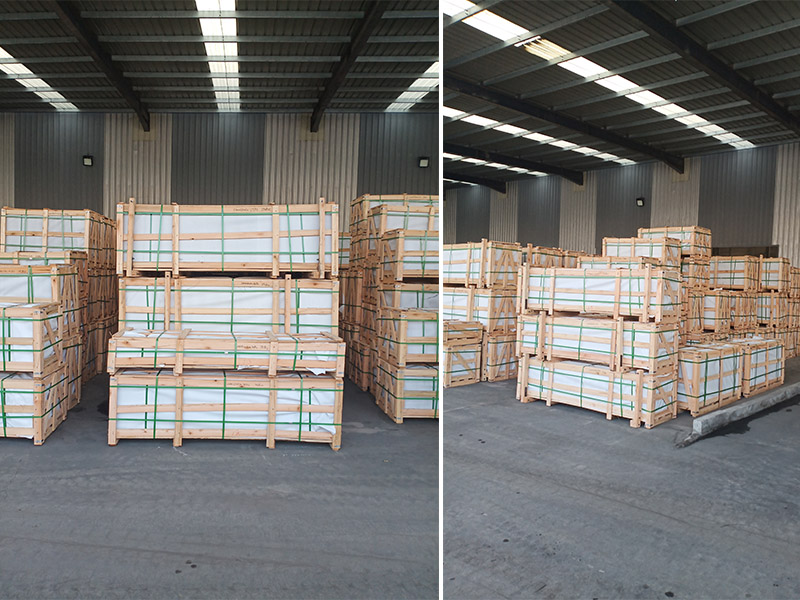
La sujeción se realiza mediante al menos cuatro correas transversales de PET de 16 mm por bulto, con los puntos de cruce bloqueados con alambre de hierro y protectores de borde debajo de la correa para evitar que dañe el arista. Los bultos pesados llevan una pretina de hierro de 20 mm en cada extremo. El peso máximo del bulto es de 2,5 toneladas, un límite establecido por lo que se puede manipular de forma segura en ambos extremos del trayecto, no por la capacidad de carga del bastidor.
Cada paquete se etiqueta en un lateral antes de salir de la zona de embalaje: variedad, especificación, cantidad, número de paquete.
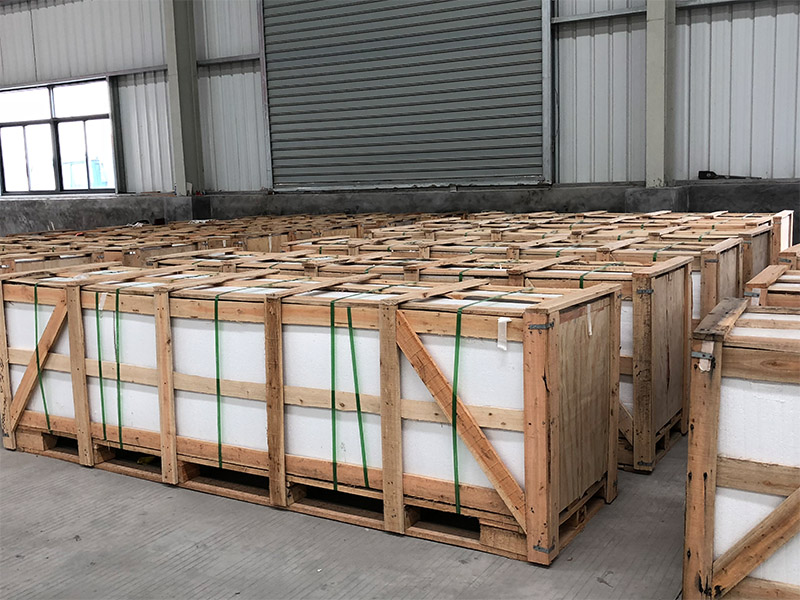
Las baldosas y las piezas del proyecto, cortadas a medida, se colocan en cajas de madera con una capacidad máxima de 1,5 toneladas.
Las cajas se construyen con tablas y perfiles cuadrados estándar. La base tiene un grosor de 18 a 25 mm, y se amplía a 20 mm o más cuando la caja está muy cargada. Las paredes tienen un grosor de 12 a 18 mm; las cajas de más de 1,5 m de altura tienen un grosor de 18 mm con refuerzos laterales. En el interior, una lámina de EPE de 10 a 20 mm cubre todas las superficies que entran en contacto con la piedra, con protectores de bordes en las aristas.
We crate the same or closely similar specifications together. Pieces stack face to face and back to back, which halves the number of polished-against-unpolished contacts and cuts friction in transit. They go in tight against each other, no gaps and no looseness. Styrofoam lines the inside of the crate. Multi-layer packing takes a board and a foam layer between each layer, and where small pieces run in several rows, a board divides every row.
Two things happen before a crate is filled. It is set down stable, or tilted slightly backwards, so pieces lean back and cannot tip out during loading. And stone waiting to be packed never sits on the floor — rubber pads or timber strips go underneath it.
Crate width is set so it divides into the 20 ft container's internal width of roughly 2.35 m. Get that wrong and you spend the loading day filling voids.
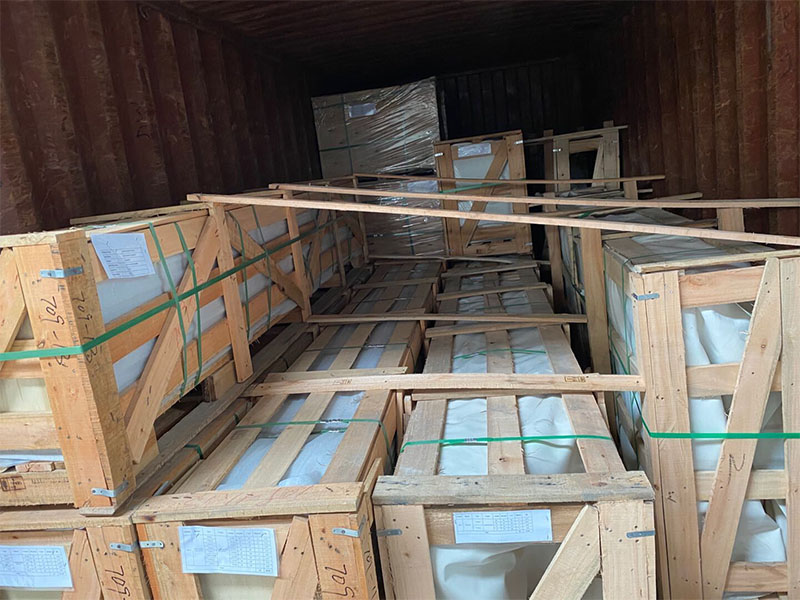
Before a crate closes, the variety, specification and quantity inside are counted against the packing list and written on a label fixed to the side.
All wood packaging leaving us is ISPM 15 compliant, fumigated with methyl bromide, and marked MB.
ISPM 15 is the IPPC standard for solid wood packaging in international trade. It recognises four treatments: heat treatment (HT, core temperature of 56 °C held for 30 minutes), methyl bromide fumigation (MB), dielectric heating (DH) and sulphuryl fluoride (SF). Ours is MB.
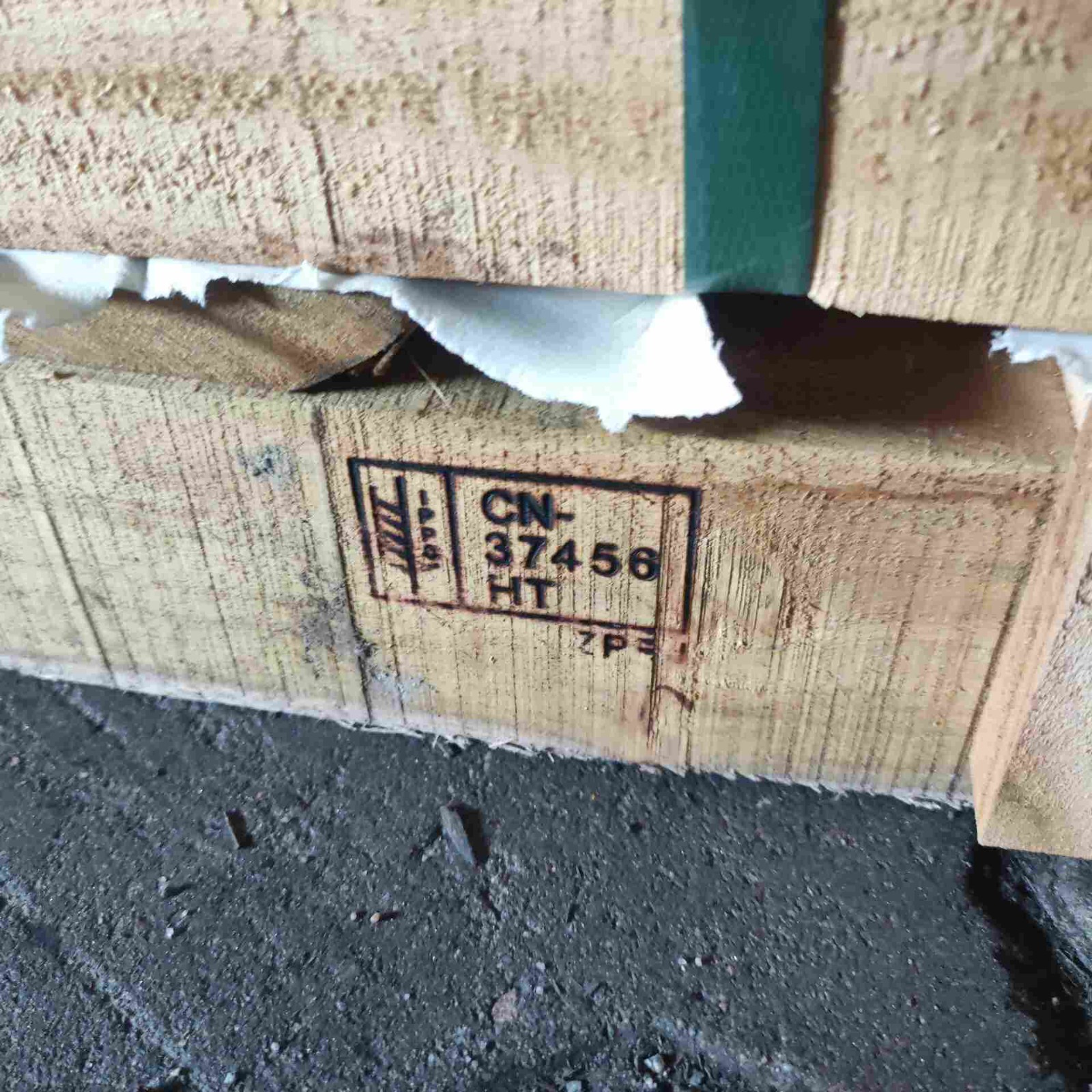
The mark itself is the compliance evidence, not a certificate sitting in a file somewhere. It carries the IPPC symbol, the two-letter ISO country code for where the wood was treated, the treatment provider's unique certification number, and the treatment abbreviation. That is what quarantine reads at the border. We can send you a photograph of it with the treatment documentation for your shipment.
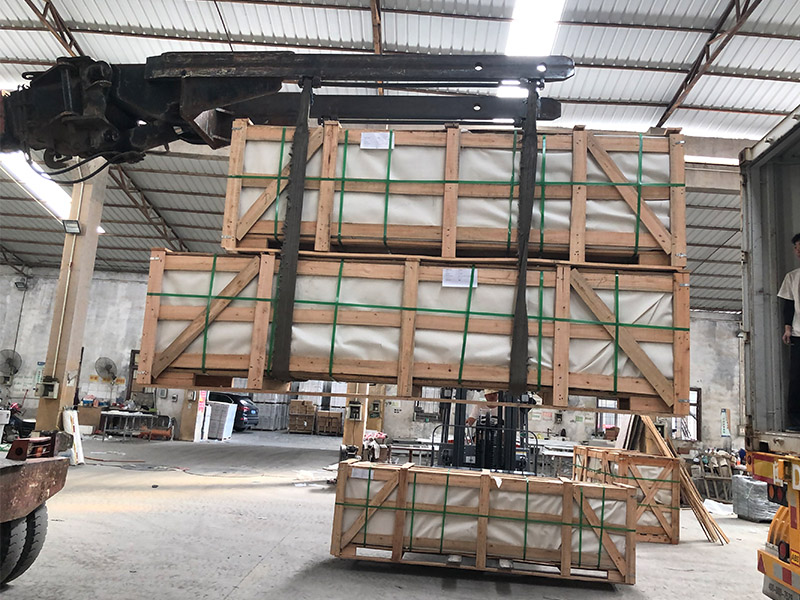
A container of marble hits its weight limit while it is still less than half full, so loading marble is a weight problem before it is a space problem.
Bundles go in along the centre line and spread down the length of the container, so the weight is not sitting over one axle position. That is what keeps the box legal on the road at the far end, not just safe at sea.
We stack staggered, not in straight columns, so vertical load is not running through a single line of frames. Anti-slip rubber strips go between bundles. Voids get braced and filled at loading — a void left alone closes up at sea, and the load shifts with it.
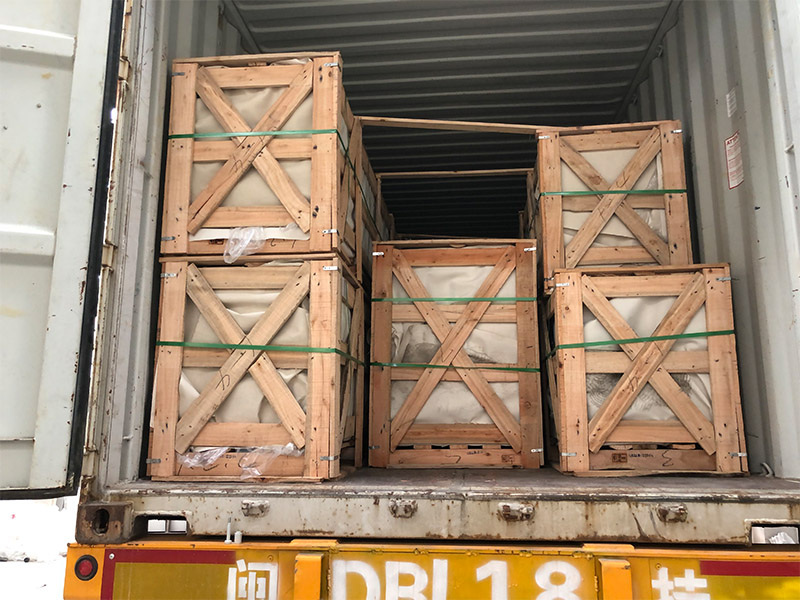
Crates carry a centre-of-gravity mark, lifting points and a moisture label, so whoever opens the container at the other end is not guessing. For securing and weight distribution we work to the IMO/ILO/UNECE CTU Code, which is the international reference for packing cargo transport units.
Short answer:a 20 ft container takes 8–12 bundles at 18–22 tonnes net, which is roughly 330–410 m² in 2 cm or 220–270 m² in 3 cm.
The longer answer matters more, because the figures published for this vary so widely that they are hard to use. Four things move the number: slab format, thickness, the weight of the packing itself, and the road weight limit at the destination. Here is how to work it out for your own order.
Marble runs at roughly 2.7 tonnes per cubic metre. That gives:
At the two common big-slab formats:
| Slab format | Area | Weight at 2 cm | Weight at 3 cm |
|---|---|---|---|
| 2400 × 1200 mm | 2.88 m² | approx. 156 kg | approx. 233 kg |
| 3000 × 1500 mm | 4.50 m² | approx. 243 kg | approx. 365 kg |
1. The container.A 20 ft box is rated at about 30,480 kg gross. Tare runs 2,200–2,400 kg, so structural payload lands around 28,000 kg.
2. The road limit at the destination.This is almost always the real constraint, and it is why published container figures differ so much. In the United States the federal Interstate limit is 80,000 lb gross vehicle weight, with 20,000 lb on a single axle and 34,000 lb on a tandem. Take out tractor, chassis and container tare, and the cargo weight buyers work to sits well under the container's structural payload. European and Australian limits bite the same way at different numbers.
3. The packing.Timber frames and crates are part of the gross weight. They are not free carriage.
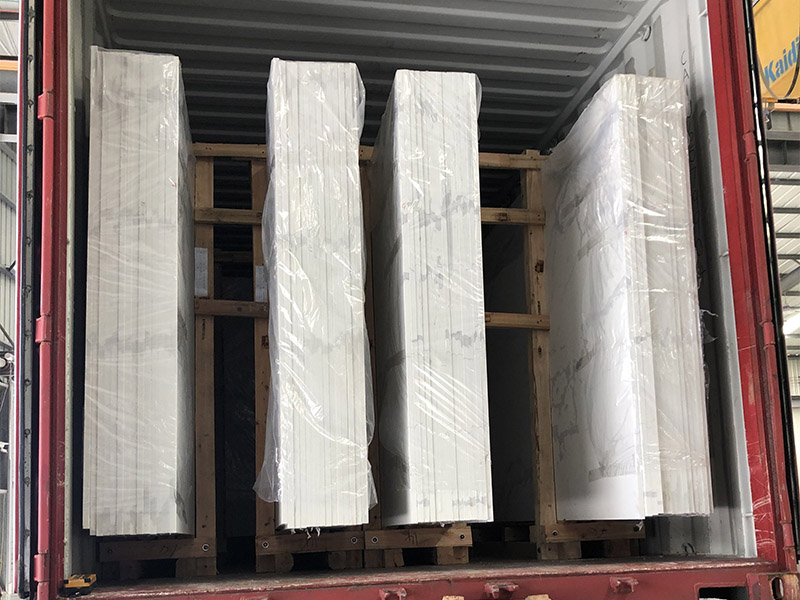
A 20 ft container of marble big slabs normally takes8–12 bundles at 18–22 tonnes net. Against the figures above, that is roughly330–410 m² in 2 cm, or220–270 m² in 3 cm. Exact quantity depends on the format and thickness you order; formats vary between different marble materials, and so does the number of slabs a bundle will take.
Tell us the road weight limit you work to at your destination and we load to it. That is a much cheaper conversation before the container is booked than after it is turned away at the port.
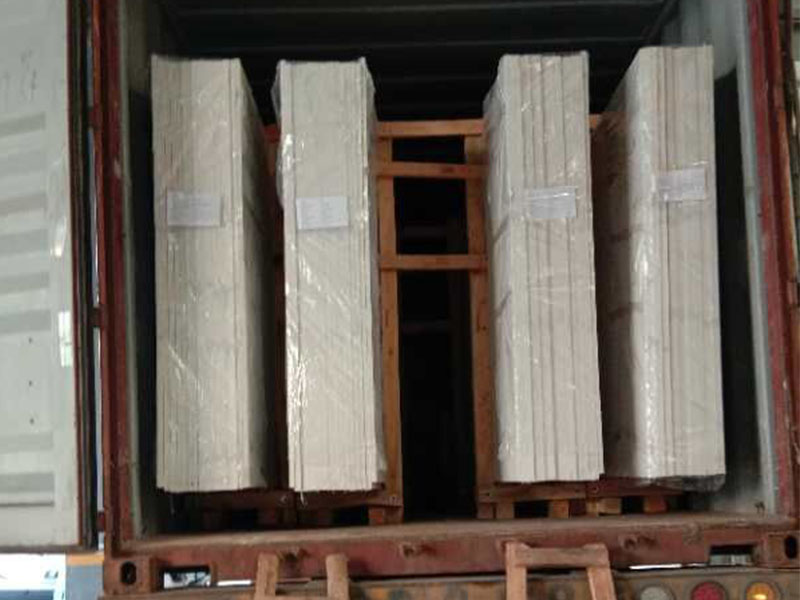
At 2.7 t/m³ a 40 ft container reaches its weight limit long before it is full, so you pay freight on space you cannot fill. Marble moves in 20 ft boxes for the same reason blocks do. A 40 ft only makes sense on lighter or lower-density material.
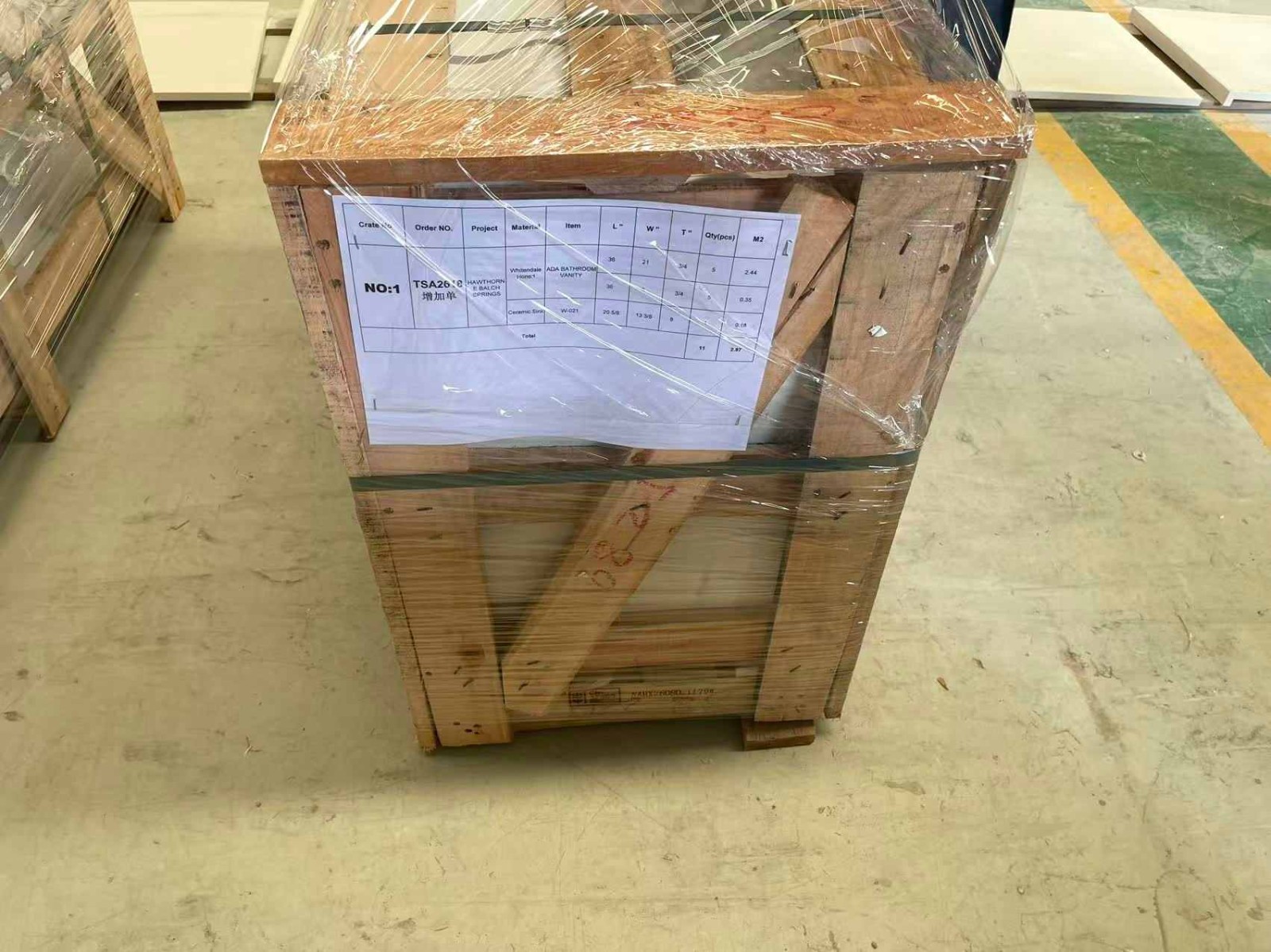
Nothing is packed until it has passed final inspection, and nothing is sealed until QC has signed for it.
Pieces are counted against the packing list, cleaned, and visually checked. Anything that fails goes back to QC and the workshop to be remade. The packer records what went into each crate and bundle, and a QC inspector confirms and signs before the crate closes. That is part ofour serviceon every order.
What it leaves you holding:
If a claim ever has to be made, this is the paperwork that settles it quickly, and it costs nothing to have it on file.
Everything above is our standard build. It can be adjusted, and order stage is when to say so — not once the container is booked.
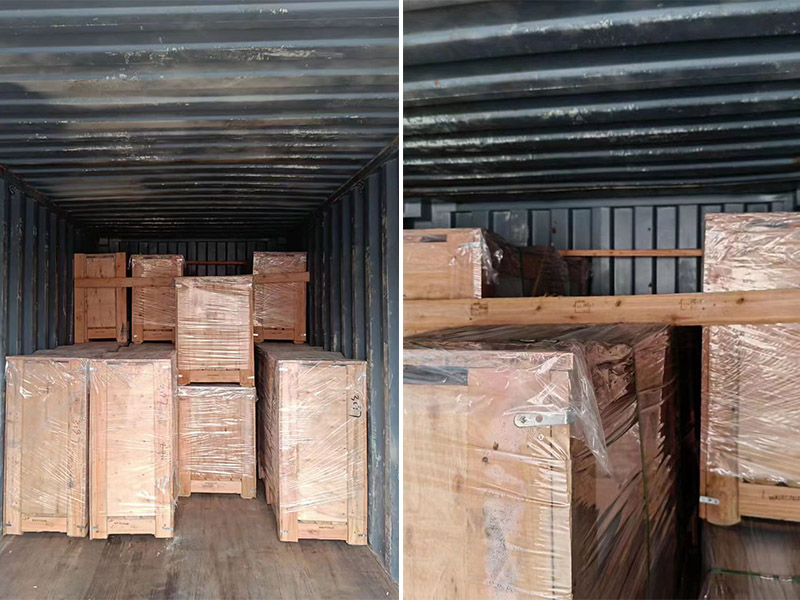
Specify none of it and you get the standard build above, which is set up for a normal 20 ft ocean shipment.
Is your wood packaging ISPM 15 compliant?
Yes. All crates and frames are ISPM 15 compliant and fumigated with methyl bromide. Each one carries the IPPC mark showing the country code, the certification number and the MB treatment code.
How many marble slabs fit in a 20 ft container?
A 20 ft container of big slabs normally takes 8–12 bundles at 18–22 tonnes net, which works out at roughly 330–410 m² in 2 cm or 220–270 m² in 3 cm. The limit is weight, not space.
Can you load to our destination's weight limit?
Yes. Tell us the limit you work to and we load the container to that figure instead of to its structural capacity.
Do you heat treat or fumigate the timber?
We fumigate with methyl bromide. The IPPC mark on the timber carries the MB code. ISPM 15 also recognises heat treatment, dielectric heating and sulphuryl fluoride, and any of the four is valid for import.
Why does marble ship in 20 ft containers rather than 40 ft?
Marble weighs about 2.7 tonnes per cubic metre. A 40 ft container reaches its weight limit well before it is full, so the extra space cannot be used and you pay freight on it anyway.
What should we do if slabs arrive damaged?
Fotografía el embalaje antes de abrirlo y luego fotografía los daños en la caja o el paquete. Envía estas fotos junto con las de la carga y la lista de empaque del envío. Comparar el estado de llegada con el estado de carga facilita la resolución de una reclamación, por lo que conviene conservar el registro de carga incluso cuando no ocurre ningún problema.
¿Podemos especificar nuestro propio embalaje?
Sí. El embalaje se puede adaptar a sus necesidades. Indíquenos las especificaciones al realizar el pedido y las confirmaremos antes de que comience la producción.
Envíenos el material, el formato y el destino.
Le facilitaremos las especificaciones de embalaje y la cantidad de contenedores necesarios para su pedido, para que conozca el peso total antes de reservar la caja.Contáctanos.
 ROOM 205,NO.45, MIDDLE HAIJING ROAD,XIAMEN,AREA OF PILOT FREE TRADE ZONE(FUJIAN)OF CHINA
Para Consultas sobre nuestros productos o su lista de precios, por favor, déjanos a nosotros y estaremos en contacto dentro de las 24 horas.



© Derechos de autor: 2026 XIAMEN EXCELLENT STONE CO.,LTD. Reservados todos los derechos.

Red IPv6 admitida