español




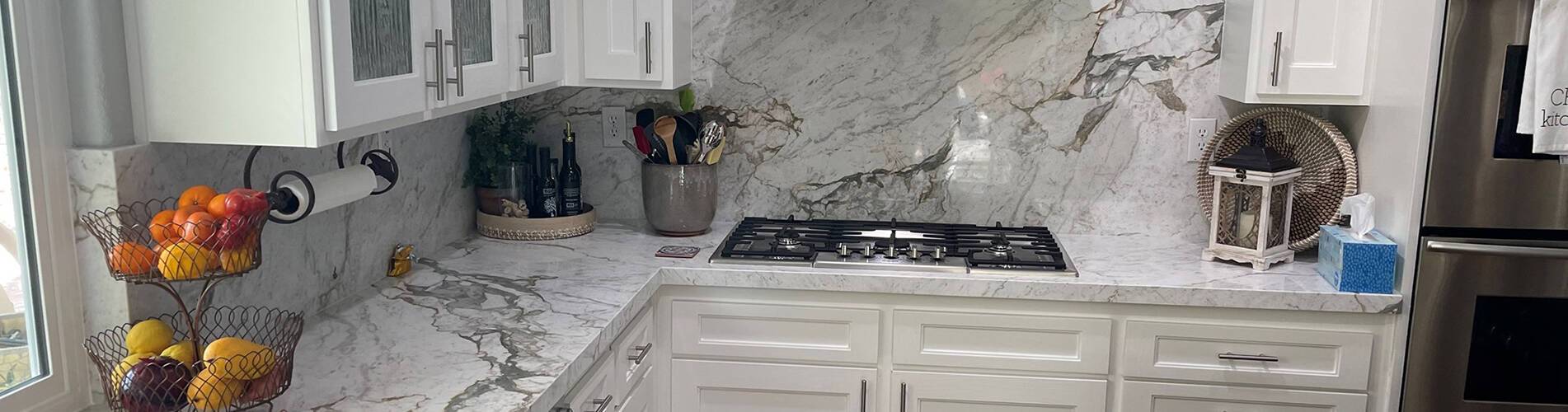
Respuesta rápida:El mármol blanco se torna amarillo por cinco razones distintas: oxidación de minerales accesorios que contienen hierro en el interior de la piedra; activación y transporte de hierro o contaminantes por la humedad; transparencia de los materiales de colocación y el sustrato a través de la piedra translúcida; cera, recubrimientos o suciedad en la superficie; y hierro externo proveniente de metales, tuberías o agua. La oxidación interna del hierro es la causa que la mayoría de la gente menciona primero, y nombrarla primero es el error de diagnóstico más común. Antes de elegir cualquier tratamiento, determine si el color se encuentra en la superficie del mármol, en su interior o en la parte posterior. Los datos de absorción de agua no pueden responder a esa pregunta. El patrón, la ubicación, el momento, las condiciones de humedad y la mineralogía sí pueden.
Tabla de contenido
El mármol blanco puede adquirir tonalidades amarillas, naranjas o marrones cálidas debido a diversos mecanismos, cada uno con sus propias necesidades. La respuesta habitual en la industria —la oxidación del hierro— es una causa real e importante, pero partir de ahí suele llevar a la gente a usar quitamanchas cuando el problema real reside en una capa de cera, una losa húmeda o un accesorio metálico a cinco centímetros de distancia.
Por lo tanto, la primera pregunta no es "¿qué limpiador debo usar?", sino:
¿El color amarillo está en la superficie, en el interior del mármol o se aprecia visualmente desde detrás?
A partir de ahí, el patrón, la ubicación, el momento, las condiciones de humedad y el historial de instalación determinan qué investigar.

El mármol blanco está compuesto principalmente de minerales carbonatados, pero el mármol natural también contiene minerales accesorios, entre ellos:pirita, hematita y otros minerales que contienen hierro.En condiciones adecuadas de humedad y oxígeno, estos se oxidan y producen una decoloración amarilla, naranja o marrón.
La forma en que se distribuyen determina el aspecto del problema. Los minerales que contienen hierro pueden encontrarse en una bolsa aislada, seguir una veta natural o dispersarse por un área más amplia, por lo que la decoloración relacionada con los minerales aparece como una mancha aislada de color marrón anaranjado, como un amarilleamiento que sigue una veta o como una coloración difusa de color marrón amarillento.
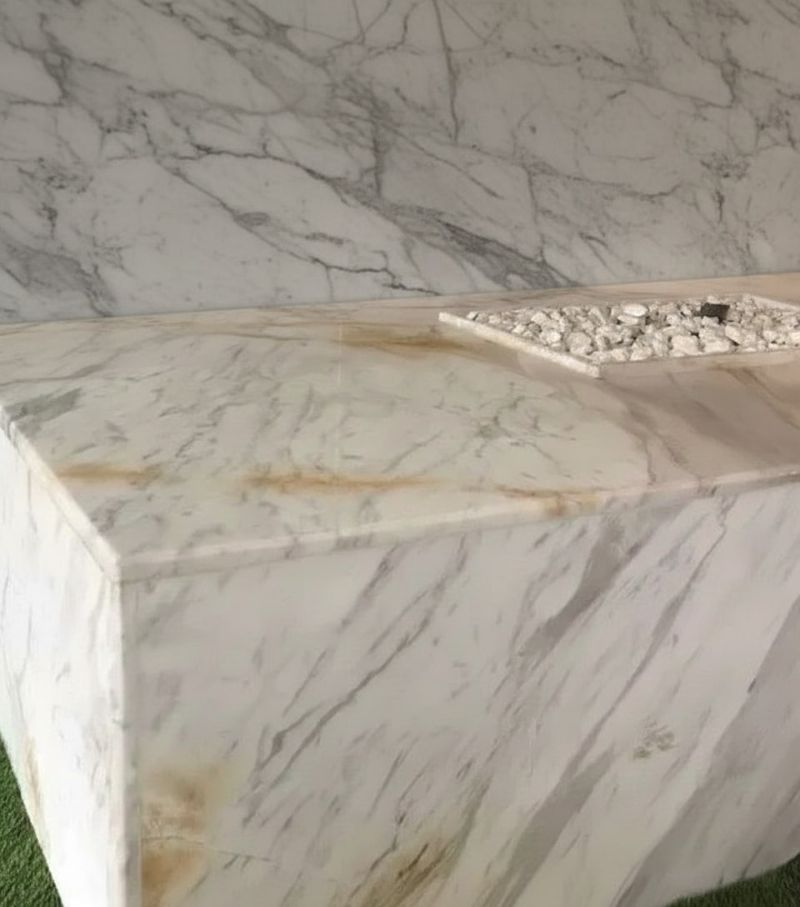
Hay un punto que conviene aclarar, porque se suele afirmar lo contrario:La calcita y la dolomita no son la fuente del óxido. Los minerales accesorios que contienen hierro sí lo son.El mármol blanco no amarillea por tener un alto contenido de carbonato. Amarillea cuando algo dentro o alrededor de él le aporta hierro y algo le aporta agua.

La humedad se suele describir como causa del amarilleamiento, pero el agua rara vez aporta el pigmento amarillo en sí. Lo que hace es promover la oxidación de los minerales que contienen hierro, transportar compuestos de hierro solubles a través de la piedra, arrastrar contaminantes desde el lecho de engaste o el sustrato y mantener la piedra húmeda el tiempo suficiente para que se produzca la decoloración.
Esa distinción tiene una consecuencia práctica: secar o sellar la superficie del mármol no afecta ni al material ni a la fuente de humedad que se encuentra debajo.

El mármol blanco, ligero y translúcido, deja entrever lo que hay debajo. Un adhesivo gris, un sustrato oscuro, una cobertura irregular o una base constantemente húmeda pueden alterar el tono visible, aunque el mármol en sí no experimente ninguna reacción con el hierro. Los materiales de colocación también pueden generar problemas químicos y de compatibilidad, especialmente con piedras sensibles a la humedad o con respaldo de resina.
Por lo tanto, antes de aplicar cualquier tratamiento, es necesario diferenciar entre el amarilleamiento químico y la transparencia óptica. Las variables de instalación que influyen en ambos fenómenos se explican en detalle más adelante.
La acumulación de cera, el envejecimiento de los recubrimientos superficiales, los residuos de mantenimiento y la suciedad atrapada en un acabado desgastado hacen que el mármol blanco adquiera un tono ámbar o amarillo. Antes de diagnosticar cualquier problema interno, determine si la decoloración se encuentra en la superficie de la piedra.
El hierro externo constituye una categoría aparte. Los elementos de fijación metálicos, los componentes de fontanería, las patas de los muebles y el agua con contenido de hierro producen manchas de color marrón anaranjado sin que el mármol sea la fuente del hierro.
El mármol blanco puede ser predominantementecalcítico, predominantementedolomíticoo una mezcla de ambos minerales carbonatados. La distinción es real, pero no funciona como regla para determinar el amarilleamiento.
La clasificación por sí sola, entre calcítica y dolomítica, no predice el amarilleamiento similar al de la oxidación.
El mármol dolomítico aún contiene pirita, hematita y otros minerales accesorios que contienen hierro. La cuestión importante no es qué carbonato predomina, sino si los minerales que contienen hierro están presentes en la selección de la piedra.
La misma precaución se aplica a los datos de absorción. Una piedra puede tener una baja absorción de agua y aun así contener minerales con hierro localizados, por lo que los datos de absorción y la mineralogía nunca deben considerarse intercambiables.
Esta es la primera división más útil y también la más económica: las causas superficiales se pueden confirmar o descartar en una tarde, mientras que la investigación mineralógica es lenta y costosa. Descarte la capa superior antes de abrir la piedra.
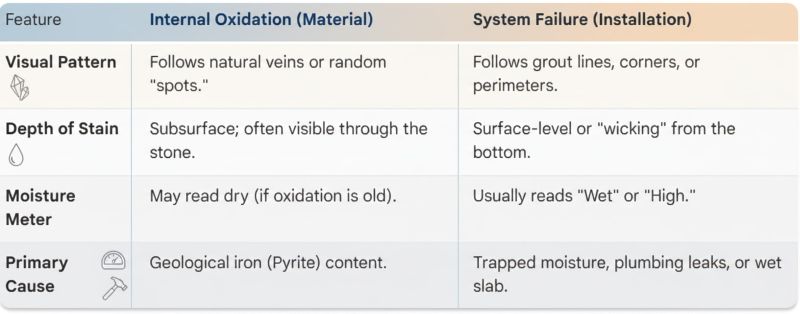
Compruebe primero la superficie cuando la decoloración se presente como una película ancha de color ámbar o cerosa, se concentre en las zonas de mayor tránsito, aparezca junto con una pérdida de brillo o se produzca tras un historial conocido de aplicación de cera o algún recubrimiento superficial.
Una limpieza profesional controlada o una prueba de decapado lo solucionará. Si el revestimiento se desprende y la piedra vuelve a ser blanca, la decoloración era un problema superficial.
La decoloración interna de los minerales cobra prioridad cuando se observan manchas minerales aisladas de color marrón anaranjado, manchas que siguen las vetas naturales, una coloración marrón amarillenta difusa con profundidad visible o una decoloración que no se modifica tras una limpieza superficial normal.
En ese momento, compare las condiciones de humedad en toda la instalación y, cuando el valor del proyecto lo justifique, examine la mineralogía de la piedra.
El mármol translúcido deja ver lo que hay debajo: adhesivo gris, un sustrato oscuro, huecos en el mortero, diferencias en el grosor del adhesivo y zonas húmedas y secas bajo la piedra. Por lo tanto, un tono cálido o gris amarillento no implica automáticamente un amarilleamiento químico.
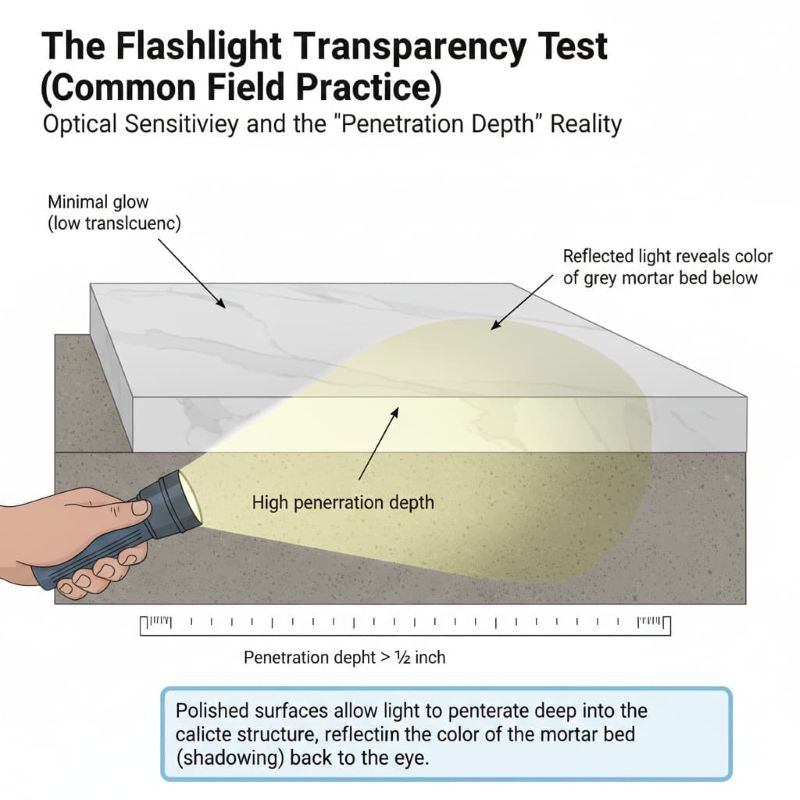
Antes de tratar el mármol amarillo, determine si el color está en la superficie de la piedra, en su interior o si se manifiesta desde la parte posterior.
Pattern no reemplaza las pruebas, pero establece el orden de la investigación, y la lógica subyacente es simple:
Cuanto más regular y repetible sea la geometría de la decoloración, menos probable será que la variación natural aleatoria se convierta en una primera explicación.
La geología de la piedra natural produce una distribución irregular de los minerales. No reproduce la geometría de la construcción.

| Lo que ves | Investiga primero |
|---|---|
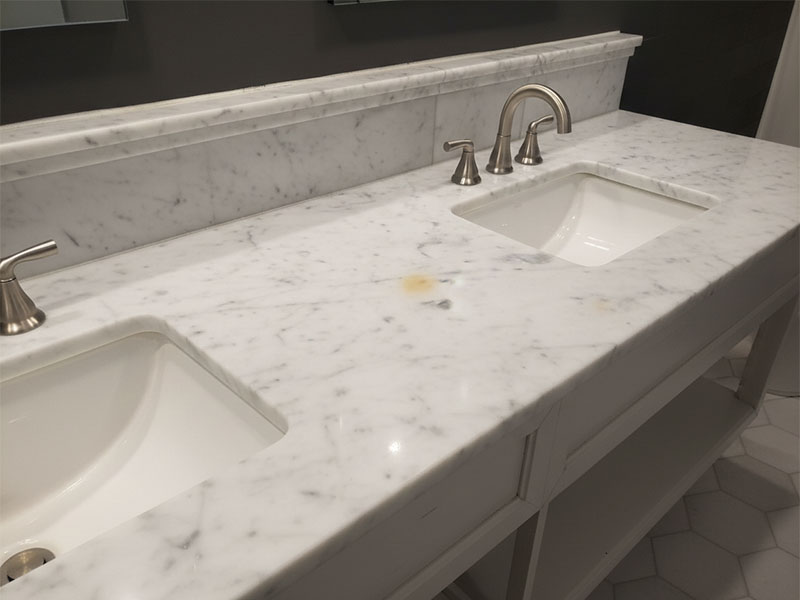
| Mancha aislada de color marrón anaranjado, sin relación con juntas o mortero. | Mineral de hierro localizado o metal externo en contacto |
| El amarilleamiento sigue una veta natural en lugar de una línea de lechada. | Concentración de minerales dentro de esa veta |
| Patrón de cuadrícula regular | Soporte de malla o resina, y el adhesivo de soporte. |
| Marcas de llana, puntos adhesivos, geometría de la cobertura de mortero | Material de ambientación, cobertura y transparencia óptica |
| Línea amarilla a lo largo de una costura | Adhesivo para juntas, borde expuesto, humedad localizada |
| Borde alrededor de cada azulejo o panel ("enmarcado de cuadro") | Absorción en los bordes, humedad del lecho de siembra, secado diferencial |
| Anillo amarillo alrededor de un desagüe, recorte o penetración. | Fugas, lecho de asentamiento húmedo, borde cortado, metal cercano, calidad del agua |
| Solo cambia el borde cortado expuesto. | Humectación repetida de los bordes, tratamiento de fabricación, adhesivo para bordes |
| Película ámbar ancha | Recubrimiento de cera o tópico |
| Same pattern repeats across many pieces | Processing or installation system, not the individual slab |
| Only one slab changes | Local exposure, fabrication history, or mineral variation |
A yellow ring around a drain tells you to trace the water path first. It does not identify the chemistry of the stain.

Do not label a single affected slab "natural variation" by default. Compare it against its neighbors on moisture exposure, mortar coverage, resin or mesh backing, fabrication repairs, cut edges, and proximity to metal or water sources.
Only when adjacent slabs share the same installation and moisture conditions and just one has changed color does mineralogy and fabrication history become the leading explanation.
Timing shifts the investigation order. It does not identify the cause on its own.
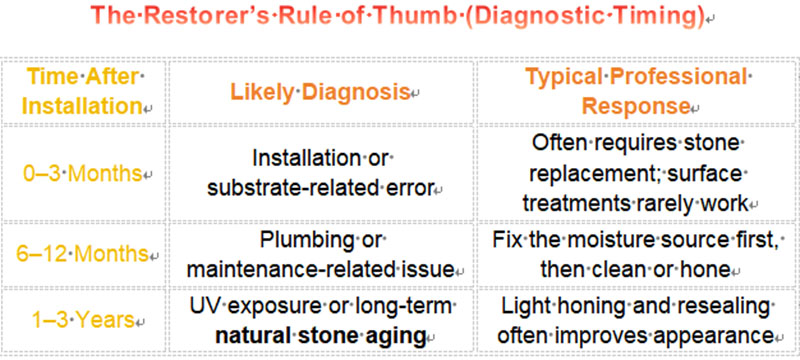
Discoloration appearing shortly after installation points to the installation system: installation moisture, substrate condition, mortar color, moisture-sensitive stone, adhesive compatibility and optical show-through.
"Natural aging" explains nothing about discoloration that appears within weeks of installation.
Mineral-related discoloration does not have to appear quickly. Diffuse yellow-brown staining associated with iron-bearing minerals is documented developing well after installation, on stone that looked entirely correct through its first months of service.
The consequence is that passing visual inspection at handover clears nothing. A quiet first year is not evidence that the minerals are inert; it may only mean the moisture path has not yet done enough work. When delayed discoloration is diffuse or vein-related and the installation carries a continuing moisture history, investigate the minerals and the moisture path together.
Flooding makes moisture and iron the immediate priorities, but it does not establish where the iron came from. It may originate in the stone, in plumbing, in groundwater, or in the flood water itself. Check the marble and the water source.
Once installed, marble stops being an isolated slab.
It becomes one layer in a moisture-transport and drying assembly.
That assembly can include concrete or screed, waterproofing, mortar or thinset, adhesive, the marble, grout, seams, backing materials and surface treatments. Four decisions inside it drive most early yellowing.

White setting material.White thinset is the safer visual choice for white and translucent marble, because the stone reveals the tone of the bed. Gray mortar or a dark substrate creates warm or shadowed areas with no internal iron reaction involved.
Rapid-setting mortar.This addresses a different problem. White mortar solvescolor compatibility; rapid-setting mortar limitsexposure to installation waterfor stone that reacts poorly to prolonged moisture. For more sensitive materials, a reaction-resin system may be appropriate where the stone and adhesive manufacturers both support it. These are not interchangeable decisions, and choosing white mortar does not address moisture at all.
Resin and mesh backing.Some slabs and tiles are reinforced with resin and fiber mesh, which adds another material interface. Certain mesh adhesives are moisture-sensitive, and the weak point is often the bond between backing and stone rather than between mortar and backing. A regular mesh-like grid in the discoloration points at the backing system before it points at random mineral oxidation.
Backing condition is a supplier-side fact, not something an installer should have to discover on site. We identify whether the marble we supply carries resin or mesh backing so the setting system can be chosen around it rather than against it.
Substrate moisture.Concrete and screed are not dry because a certain number of days have passed. Verify the actual moisture condition and compare it against the requirements of the selected mortar, membrane and installation system.
Each test answers one question. Most disputes about yellowing come from using a test to answer a question it was never designed for.
| Test or Check | What It Tells You | What It Does Not Tell You |
|---|---|---|
| ASTM C97 | Water absorption and bulk specific gravity | Whether the stone contains pyrite or will yellow |
| ASTM C503 | Physical requirements for marble dimension stone | A proven yellowing threshold |
| ASTM C1721 | Petrographic and mineralogical information relevant to staining and color change | Guaranteed future field performance |
| ASTM F2170 | Internal relative humidity of concrete | Which mineral caused a yellow stain |
| ASTM F1869 | Concrete moisture vapor emission, reported as lb/1,000 ft²/24 h | Whether the marble contains iron |
| Comparative moisture reading | Whether the affected area is wetter than a control area | The chemistry of the stain |
| Full-system mockup | Visual and installation compatibility | Every possible long-term field condition |
ASTM C503 sets a maximum water absorption of0.20%for calcitic and dolomitic dimension marble.
That is a physical-property requirement, not a yellowing threshold.
Meeting it proves nothing about pyrite, hematite or other localized iron-bearing minerals in the batch.
ASTM C97 measures how much water the stone absorbs under the test method. Petrographic examination such as ASTM C1721 investigates which minerals and constituents are actually present.
Where the concern is internal iron-related discoloration, mineralogical information is directly relevant and a low absorption number is not. Absorption and mineralogy are simply not the same property.
ASTM F2170 and F1869 establish whether the concrete substrate is an active moisture variable. They say nothing about whether the yellow pigment came from pyrite, external iron, an adhesive or another source. A higher moisture reading in a yellow area supportsmoisture involvement, not a specific chemical diagnosis.
A project-specific72-hour soak testis a reasonable screening step: it can expose fast-reacting material before that material reaches the job. What it cannot do is clear a stone for long-term service. Mineral-related staining develops over months, and installation conditions include variables a short water test does not reproduce.
Restoration potential depends entirely on which layer changed color, and the range runs from routine to unrecoverable.
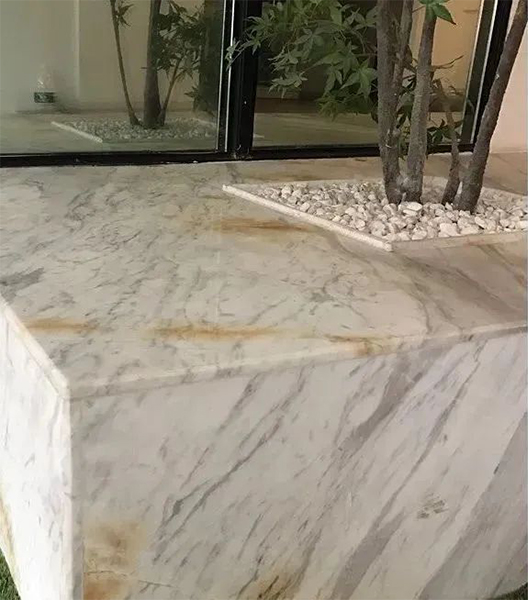
| Diagnosis | Restoration Outlook | What Has To Happen First |
|---|---|---|
| Wax, coating, maintenance residue or trapped dirt | Usually reversible | Controlled cleaning or stripping test |
| External iron source | Reversible once the source is gone | Remove or isolate the metal or water source |
| Optical show-through from the setting bed | Not a stain at all | Address as an installation issue, not a stone issue |
| Active moisture or leak | Recurs until the source is closed | Trace and stop the water path |
| Deep internal iron oxidation | Partially reversible at best | Mineralogical assessment before treatment |
Two of those rows deserve emphasis. If yellowing returns shortly after cleaning, stop repeating the same surface treatment — the source is active and below the finish. And deeply seated rust-like staining from internal minerals may improve under repeated professional treatment without ever fully clearing.
Marble is an acid-sensitive carbonate stone, and a chemical strong enough to lift iron staining is usually strong enough to etch the surface.
Removing the stain and preserving the finish are two separate problems.
Do not treat a rust-colored stain as a straightforward cleaning task before the stain type and the stone's response are understood.
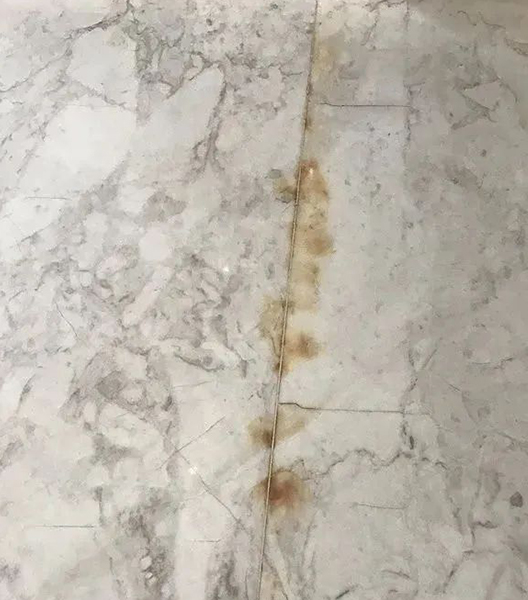
No.Annual sealing is widely recommended as yellowing prevention, and it does not work that way.
A compatible impregnating sealer reduces certain liquid exposures and improves stain resistance. It cannot remove iron already present in the marble, correct an active leak, dry a wet substrate, fix incompatible setting materials, or prevent oxidation.
Where backside or edge moisture is a known project risk, specify a treatment designed for that interface and confirm it is compatible with the bonding system. A blanket "seal all five sides" rule is not a substitute for that decision.
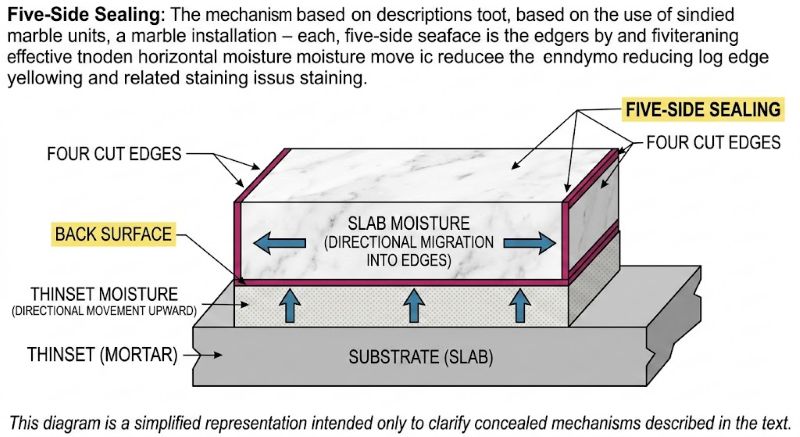
Commercial stone names do not guarantee identical accessory-mineral distribution between slabs, so specifying by name alone leaves the main variable uncontrolled. Review the actual slabs or batch for calcitic or dolomitic mineralogy where relevant, visible mineral spots, vein characteristics, translucency, resin or mesh backing, and any known moisture sensitivity.
This is the point where a supplier either helps or gets in the way. As a marble factory, we work from the specific batch rather than the commercial name: we show the actual slabs reserved for a project, point out visible mineral spots and how the veining behaves across the pieces, and state the backing condition of the material as supplied. None of that predicts field performance by itself. It does move the decision from a name to a material.
Questions worth putting to any white marble supplier before an order is confirmed:
A supplier who cannot answer the first two is describing a name rather than a shipment.
Specify the stone together with the substrate, mortar or adhesive, waterproofing, grout, backside or edge treatment, and surface treatment. For resin-backed or moisture-sensitive marble, confirm compatibility before full installation rather than after.
For large commercial, hospitality and other high-value white marble projects, the mockup should include the actual marble, substrate, setting material, backing condition, grout and any relevant surface or backside treatment.
A full-system mockup exposes show-through, coverage differences, moisture marks and material incompatibility while the problem is still limited to one panel instead of an entire floor.
Compruebe la humedad del hormigón o la solera, el drenaje, la impermeabilización, las fugas, los bordes cortados expuestos y las condiciones de secado. La antigüedad no es una prueba de humedad.
Cuando el mármol blanco comience a ponerse amarillo, proceda con él en este orden:
La evidencia solo funciona en combinación:
Patrón + ubicación + momento + humedad + historial de instalación + mineralogía
Ninguna lectura de humedad, valor de absorción o patrón visual por sí solo reemplaza esa secuencia.
El amarilleamiento del mármol blanco debe diagnosticarse antes de su tratamiento, y el diagnóstico comienza por la ubicación de la coloración, más que por su causa. Primero, se debe determinar la capa afectada y, a continuación, utilizar la geometría, la ubicación, el momento de aparición y las condiciones de humedad para decidir si la investigación corresponde a la piedra, la superficie o el sistema de instalación. En el caso de manchas internas de color amarillo-marrón sin resolver, la evidencia mineralógica tiene mayor peso que cualquier valor de absorción.
Los problemas de amarilleamiento suelen tener su origen en una decisión tomada mucho antes de la obra: una selección basada en un nombre comercial y una fotografía de muestra, sin especificar el lote, el soporte ni el sistema de instalación previsto.
Suministramos mármol blanco directamente de fábrica, no mediante catálogo, en losas y piezas cortadas a medida. El lote del que procede el material para cada proyecto, el estado de su soporte y el acabado con el que se envía son aspectos que podemos identificar y documentar antes de la carga, y que se definen mejor en la fase de cotización que en una reclamación.
Si está especificando mármol blanco para un proyecto donde la exposición a la humedad, la translucidez o el estado del soporte son importantes,Indíquenos la aplicación y el sistema de instalación con el que está trabajando.y trabajaremos con el material realmente disponible. También puedesVea nuestra gama de losas, baldosas y piezas cortadas a medida de mármol blanco.para lo que está disponible actualmente.
Categorías
Nuevo blog
Etiquetas
 ROOM 205,NO.45, MIDDLE HAIJING ROAD,XIAMEN,AREA OF PILOT FREE TRADE ZONE(FUJIAN)OF CHINA
Para Consultas sobre nuestros productos o su lista de precios, por favor, déjanos a nosotros y estaremos en contacto dentro de las 24 horas.



© Derechos de autor: 2026 XIAMEN EXCELLENT STONE CO.,LTD. Reservados todos los derechos.

Red IPv6 admitida